
Heidelberg · Launching 1 October 2026

A new institute for medical AI

IMAI brings together research, clinical applications, and education in medical AI at Heidelberg University Hospital. Its founding director will hold the Hopp Foundation Professorship for Artificial Intelligence in Medicine at Heidelberg University.

Mission and mandate

Medical AI from research to practice

IMAI supports AI research, clinical practice, and teaching across the Heidelberg-Mannheim hospital alliance and the Heidelberg Faculty of Medicine.

Research groups develop new methods and test them with clinical partners. The Innovation & Implementation Center works with clinical teams to take research prototypes through prospective evaluation and monitors their use in clinical practice.

The institute expands clinical AI infrastructure, advises research groups and clinical teams, develops industry collaborations, and supports the creation of start-ups. The team includes specialists in medicine, computer science, physics, biology, engineering, and law.

Working closely with Heidelberg University Hospital’s Center for Digitalization and Information Technology (ZDI), IMAI contributes to the joint digital and data strategy of Heidelberg and Mannheim University Hospitals. This work requires structured data in secure, controlled environments, with safeguards for patient privacy and compliance with legal requirements.

Within the Health + Life Science Alliance Heidelberg Mannheim, IMAI connects medical expertise and technological innovation to accelerate translation from research into clinical practice.

01 · Discovery

Develop new AI methods

AI agents are one of IMAI’s central research areas. These systems use large language models to autonomously carry out complex tasks in multiple steps, with potential applications in diagnosis, treatment planning, and patient management. Our research also covers foundation models and AI biomarkers using imaging, pathology, genomics, and clinical records.

02 · Validation

Establish clinical evidence

Prospective and multicentre studies assess clinical usefulness, safety, reliability, and workflow effects at Heidelberg University Hospital and partner sites.

03 · Integration

Use AI in clinical care

Clinical teams introduce validated systems into their workflows and evaluate their effect on patients and staff at the university hospitals in Heidelberg and Mannheim. Implementation includes documentation, training, oversight, and monitoring.

AI can support clinicians and help them make informed decisions. Physicians remain responsible for diagnosis and treatment.

Education

Clinical AI education

IMAI develops clinical AI courses and training for students, researchers, clinicians, and other healthcare professionals.

Students

Students learn to work with medical data, develop AI systems, and bring them into practice. Teaching also covers the ethical, legal, and regulatory questions involved.

Researchers and professionals

Training covers technical methods, clinical evaluation, and implementation, alongside ethics, law, and regulation.

Science

Selected publications

Selected work led by the institute’s founding director spans clinical agents, AI safety, computational pathology, and standards for clinical use.

Nature Medicine · 2026

On-premise medical AI agents for reliable clinical decision-making
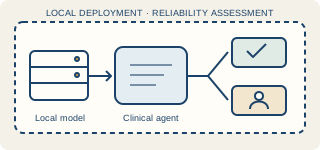
A locally hosted clinical agent assesses reliability and routes uncertain cases for clinician review

Zhang L, Wölflein G, Ferber D, …, Kather JN

View paper →
Nature · 2026

Towards autonomous medical artificial intelligence agents
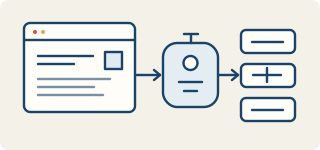
MIRA invokes clinical tools within an electronic health record

Ferber D, Hilgers L, Höper C, Kinny-Köster B, Eckardt JN, Egger-Heidrich K, ..., Jäger D, Kather JN

View paper →
Nature · 2026

Safety and security of large language models in healthcare
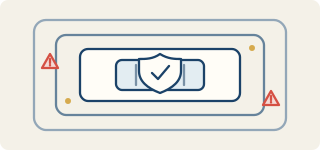
Nested safety layers protect a clinical language model

Clusmann J, Freyer O, Ostermann M, Ferber D, Ghaffari Laleh N, Hilgers L, ..., Wiest IC, Kather JN

View paper →

Lancet Digital Health · 2026

Large language models as experimental systems in human psychopathology: a modelling study
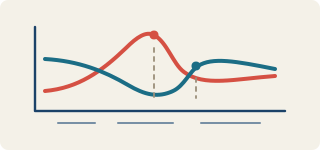
Affective-state trajectories rise after induction and fall after regulation

Wekenborg MK, Michels EAM, Kurze G, Kropp ML, Wolf F, Harzbecker J, ..., Wiest IC, Kather JN

View paper →

Annals of Oncology · 2025

ESMO Basic Requirements for AI-based Biomarkers In Oncology (EBAI)
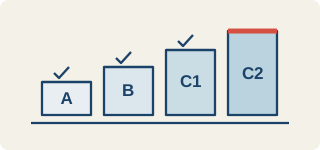
EBAI biomarker classes A, B, C1, and C2 require progressively stronger validation

Aldea M, Salto-Tellez M, Marra A, Umeton R, Stenzinger A, Koopman M, ..., Westphalen CB, Kather JN

View paper →
Annals of Oncology · 2025

ESMO guidance on the use of Large Language Models in Clinical Practice (ELCAP)
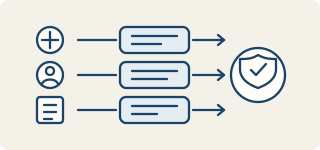
Three clinical language-model settings operate under human oversight

Wong EYT, Verlingue L, Aldea M, Franzoi MA, Umeton R, Halabi S, ..., Koopman M, Kather JN

View paper →

Nature Cancer · 2025

Development and validation of an autonomous artificial intelligence agent for clinical decision-making in oncology
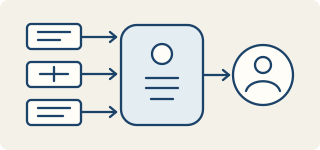
An oncology agent combines pathology, radiology, knowledge, and literature tools

Ferber D, El Nahhas OSM, Wölflein G, Wiest IC, Clusmann J, Leßmann ME, ..., Truhn D, Kather JN

View paper →

Nature Communications · 2025

Multimodal histopathologic models stratify hormone receptor-positive early breast cancer
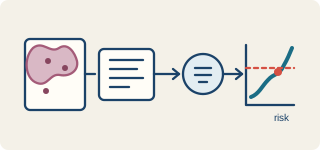
Histology and report data combine into a breast-cancer recurrence-risk estimate

Boehm KM, El Nahhas OSM, Marra A, Waters M, Jee J, Braunstein L, ..., Shah SP, Kather JN

View paper →

Nature Protocols · 2024

From whole-slide image to biomarker prediction: end-to-end weakly supervised deep learning in computational pathology
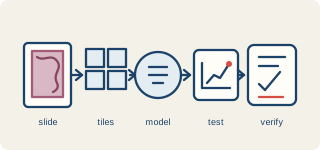
The five-stage STAMP computational pathology workflow

El Nahhas OSM, van Treeck M, Wölflein G, Unger M, Ligero M, Lenz T, ..., Truhn D, Kather JN

View paper →

Cancer Cell · 2023

Transformer-based biomarker prediction from colorectal cancer histology: A large-scale multicentric study
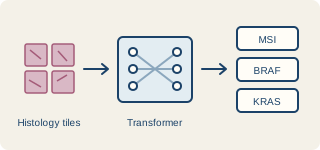
Histology tiles pass through a transformer model to predict MSI, BRAF and KRAS biomarkers

Wagner SJ, Reisenbüchler D, West NP, …, Boxberg M, Peng T, Kather JN

View paper →
Nature Medicine · 2022

Swarm learning for decentralized artificial intelligence in cancer histopathology
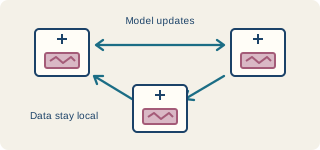
Hospitals exchange model updates while histology data stay at each site

Saldanha OL, Quirke P, West NP, …, Hoffmeister M, Truhn D, Kather JN

View paper →
Nature Medicine · 2019

Deep learning can predict microsatellite instability directly from histology in gastrointestinal cancer
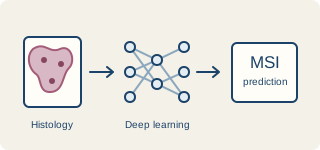
A neural network predicts microsatellite instability from a routine histology slide

Kather JN, Pearson AT, Halama N, …, Hoffmeister M, Trautwein C, Luedde T

View paper →

International network

Clinical AI across borders

IMAI is a Heidelberg hub in an international network of medical, scientific, and technical partners.

Joint research connects clinical sites and AI groups across Europe and beyond. These collaborations provide diverse data, independent validation, and the multidisciplinary expertise needed to evaluate medical AI across health systems.

Heidelberg

Clinical and technical network

Research groups, clinical departments, and shared infrastructure connect method development with clinical evaluation.

Europe

Multicentre validation and standards

Partner sites contribute independent cohorts, prospective studies, and common standards for clinical AI.

Worldwide

Shared methods and external validation

International collaborators bring complementary data, methods, and clinical expertise to joint research.

Institute structure

Research groups and institute units

IMAI consists of independent research labs and the Innovation & Implementation Center.

Each principal investigator leads a lab and sets its research programme. The IMAI office and core structures support new groups and provide access to shared clinical and technical resources.

Junior principal investigators can build independent programmes while remaining affiliated with an established lab.

Kather Lab

Research group

Kather Lab

Clinical AI, computational pathology, multimodal foundation models, language models, and autonomous agents

Led by Prof. Dr. Jakob Nikolas KatherKather Lab website →
Innovation and Implementation Center symbol

Translation

Innovation & Implementation Center

The IIC works with clinical and research teams to evaluate AI systems, address regulatory requirements, and prepare them for use in clinical workflows. It supports systems from initial assessment through implementation and ongoing quality monitoring.

Led by Dr. Isabella Bremer (née Wiest)About the IIC →
Distributed Learning and Multimodal AI symbol

Junior research group

Distributed Learning & Multimodal AI

Swarm learning, federated learning, and multimodal AI for distributed medical data

Led by Dr. Oliver Lester Saldanha About the Saldanha Lab →
Precision Oncology AI symbol

Junior research group

Precision Oncology AI

Agentic and multimodal AI for precision oncology, clinical trials, and rare cancers

Led by Dr. Julien Vibert · Co-affiliated with Gustave Roussy About the Vibert Lab →

Education Unit

Coordinates IMAI's teaching and develops education and training offerings with partners across Heidelberg and Mannheim.

IMAI Office

Manages partnerships, projects, events, and institute operations.

Technical Unit

Manages on-premises and cloud GPU computing, data storage, and technical infrastructure.

Legal and Regulatory Unit

Supports teams with governance, compliance, and regulatory pathways for medical AI.

Institute

Institute Leadership

Prof. Dr. Jakob Nikolas Kather

Prof. Dr. Jakob Nikolas Kather

Founding Director

On 1 October 2026, Professor Jakob Nikolas Kather will become founding director of IMAI and Hopp Foundation Professor of “Artificial Intelligence in Medicine” at the Faculty of Medicine at Heidelberg University. He joins from TU Dresden, where he has held the Chair of Clinical Artificial Intelligence since 2022. He is board-certified in internal medicine and holds a master’s degree in Medical Physics. Since 2020, he has also led a research group in Medical Oncology at Heidelberg University Hospital.

Dr. Silvia Barbosa
Copyright: EKFZ/Anja Stübner

Dr. Silvia Barbosa

Head of Operations

Silvia Barbosa is a scientist trained in cellular and molecular biology. She completed her doctoral research in experimental and translational head and neck oncology in Heidelberg and now coordinates IMAI operations.

Dr. Isabella Bremer
Copyright: EKFZ/Anja Stübner

Dr. Isabella Bremer (née Wiest)

Head of Innovation & Implementation

Isabella Bremer is a physician with additional training in health economics. Her research concerns the development, evaluation, and clinical implementation of large language models.

Press

Selected press coverage

Complete IMAI press archive →

MDR Wissen · 19 August 2026 · DE
Jakob Kather

Wenn die KI irrt, klingt sie trotzdem überzeugend

Read article →

Financial Times · 17 June 2026 · EN
Jakob Kather

AI medical tools match or surpass doctors for advice

Read article →

DER SPIEGEL · 26 October 2024 · DE
Jakob Kather

KI in der Medizin: Auf Heilung programmiert

Read article →

Supported by the Dietmar Hopp Foundation

The Hopp Foundation Professorship and IMAI receive funding of up to eight million euros from the Dietmar Hopp Foundation over the next five years. This funding helps translate research into safe clinical applications that benefit patients.

Funded byDietmar Hopp Foundation
Parent institutions
Heidelberg University, Future since 1386

Contact

Institute for Medical Artificial Intelligence

Heidelberg University Hospital
Heidelberg Faculty of Medicine at Heidelberg University
Marsilius Arkaden · Im Neuenheimer Feld 130.3
69120 Heidelberg · Germany

contact@kather.ai
Logo assets and brand guidance